Comprendre les imaginaires effrayants : peur, gothique et dystopie
Identifier, dans un texte ou un document en anglais, comment le gothique et la dystopie produisent la peur chez le lecteur, et expliquer ces effets en anglais avec des indices précis du texte.
Les points essentiels
- Fear in literature is not only a feeling stated by a character: it is built by the text through setting, atmosphere, point of view, rhythm and what is left unsaid.
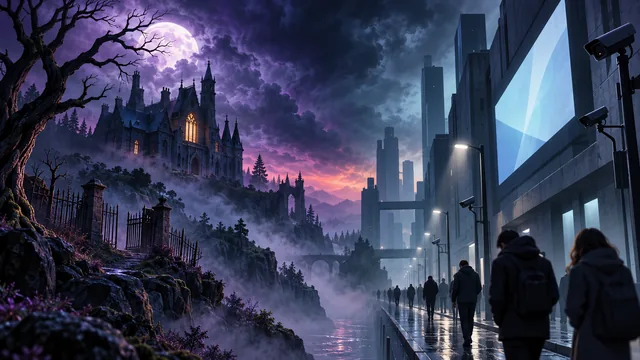
- The Gothic tradition (late 18th and 19th centuries: Walpole, Radcliffe, Mary Shelley, Poe, Stoker) relies on decaying castles and houses, night and storms, secrets from the past, the supernatural or its suggestion, and the return of the repressed.
Les mots à connaître
- Gothic
- A literary mode born in 18th-century England, which stages fear through haunted or oppressive places (castles, mansions, ruins), dark secrets, the supernatural or madness, and an atmosphere of mystery and dread.
- Dystopia
- A fictional society, usually set in the future, which appears organised but is in fact oppressive and unfree. It serves as a warning by pushing present tendencies (surveillance, propaganda, inequality, technology) to their extreme.
Un exemple pour comprendre
Read this invented extract and explain how fear is created: 'The house stood at the end of the lane, its windows dark. Rain hammered the roof. Somewhere upstairs, a door creaked open, though no one had lived there for years. Clara held her breath and listened.'
Genre: Gothic. Setting: an isolated, abandoned house, a classic Gothic place linked to a hidden past. Fear is created by atmosphere (dark windows, hammering rain), by sound ('a door creaked open') and by the unexplained: no one lives there, yet something moves. The text does not show a monster: it suggests, which is terror rather than horror. The short final sentence 'Clara held her breath and listened' slows the rhythm, puts the reader in her place and builds suspense. Answer model: The author builds fear through atmosphere and suggestion, as the unexplained creak in an empty house makes the reader anticipate danger.